ABSTRACT Likkutei Sichos on Stringency, Avodah, and Blessings
Ben Chamesh L'Mikra | November 28, 2024
Print This Article
View Original PDF

ABSTRACT Likkutei Sichos on Stringency, Avodah, and Blessings

Ben Chamesh L'Mikra | June 27, 2025

Even if one is stringent with oneself, regarding others one must give extra measure of beneficial care. Yitzchak was exact with himself, concerned about a possible earlier time (dying within 5 years of his mother’s age at death) rather than a later time (of his father); but when blessing others (Yaacov), Yitzchak blessed him with a good eye (not exacting).

לא ידעתי יום מותי

Eisav saw what happened between Yitzchak & Yaacov; then, he understood that Canaanite women were not acceptable to his father. וירא עשו is written twice; first, he saw that Padan Aram was connected to the blessing that Yaacov received; second, he understood to go to Yishmael for his daughter as a wife.

וישמע יעקב

One needs to attempt to unite chesed and gevurah; however, if in doubt go with Chesed. Avrohom is Chesed; Yitzchak is Gevurah. Even though different, miraculously they were created with similar appearances.

אברהם הוליד את יצחק

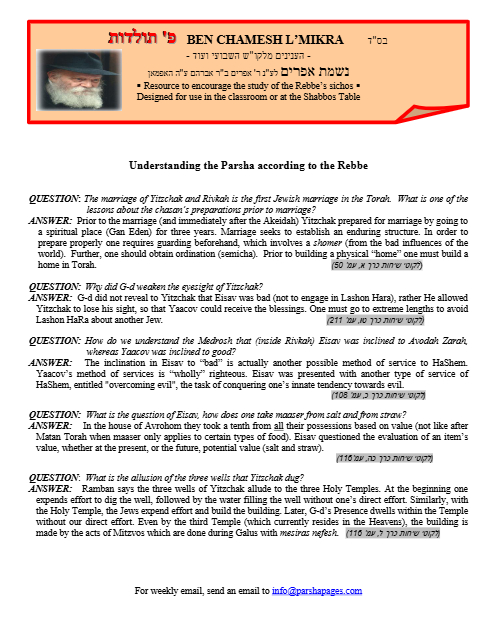
The service of “Toldos Yitzchak” is both services of “dweller of tents” and of “man of the field”; first should be learning Torah, then one can change the world. Yaacov & Eisav represent 2 types of avodah: Yaacov is "wholly righteous". Eisav is "overcoming evil", the task of conquering one’s innate tendency towards evil.

ויגדלו הנערים

Yaacov inherited the blessing given to Avrohom to have children while traveling away from home; also, the blessing to Avrohom to make his name exalted, was fulfilled with Yaacov, as the Jews are called children of Yisrael.

את ברכת אברהם

Essence of Eisav is a high source; how to make birur on the source of salt (root of gevurah) and on the source of straw (root of kelipah). In the house of Avrohom they took a tenth from all their possessions based on value (not like after Matan Torah when maaser only applies to certain types of food). Eisav questioned the evaluation of an item’s value, whether at the present or the future, potential value (salt and straw). Rashi vs. Medrosh reflects disagreement of Rambam and Raavad on maaser.

Even if one is stringent with oneself, regarding others one must give extra measure of beneficial care. Yitzchak was exact with himself, concerned about a possible earlier time (dying within 5 years of his mother’s age at death) rather than a later time (of his father); but when blessing others (Yaacov), Yitzchak blessed him with a good eye (not exacting).

לא ידעתי יום מותי

Eisav saw what happened between Yitzchak & Yaacov; then, he understood that Canaanite women were not acceptable to his father. וירא עשו is written twice; first, he saw that Padan Aram was connected to the blessing that Yaacov received; second, he understood to go to Yishmael for his daughter as a wife.

וישמע יעקב

One needs to attempt to unite chesed and gevurah; however, if in doubt go with Chesed. Avrohom is Chesed; Yitzchak is Gevurah. Even though different, miraculously they were created with similar appearances.

אברהם הוליד את יצחק

The service of “Toldos Yitzchak” is both services of “dweller of tents” and of “man of the field”; first should be learning Torah, then one can change the world. Yaacov & Eisav represent 2 types of avodah: Yaacov is "wholly righteous". Eisav is "overcoming evil", the task of conquering one’s innate tendency towards evil.

ויגדלו הנערים

Yaacov inherited the blessing given to Avrohom to have children while traveling away from home; also, the blessing to Avrohom to make his name exalted, was fulfilled with Yaacov, as the Jews are called children of Yisrael.

את ברכת אברהם

Essence of Eisav is a high source; how to make birur on the source of salt (root of gevurah) and on the source of straw (root of kelipah). In the house of Avrohom they took a tenth from all their possessions based on value (not like after Matan Torah when maaser only applies to certain types of food). Eisav questioned the evaluation of an item’s value, whether at the present or the future, potential value (salt and straw). Rashi vs. Medrosh reflects disagreement of Rambam and Raavad on maaser.

PDF Preview

