Haftorah of Sidra Vaera
Questions on the Sidra | January 08, 2024
Print This Article
View Original PDF

Haftorah of Sidra Vaera

Questions on the Sidra | December 10, 2025

This week’s Haftorah is taken from Sefer Yechezkel, Chapter 28, verse 25 — Chapter 29, verse 21

1. The common theme of the Sidra and its Haftorah is the punishment of Egypt. But there are different reasons for that punishment. The Egypt of the Sidra was punished for defying the command of HaShem to let us go free and its punishment was the series of the Ten Plagues. On the other hand, the punishment of the Egypt in the Haftorah, approximately one thousand years later, was, once again, because of Egypt’s refusal to acknowledge that HaShem is the Sovereign of the world but also for Egypt’s deceitful conduct towards the Jewish People, which, though nowhere near as cruel as the Egypt of our slavery, nevertheless did help to bring about great harm to the Jewish People.

2. At the time of our Haftorah, the world’s political scene was dominated by the kingdom of Egypt and the growing world power of Babylon (roughly where Iraq and Iran are today). Babylon’s king, Nevuchadnetzar, had his greedy eyes on the strategically-placed Land of Israel. Indeed, it is because of the Land of Israel’s central position in the world that HaShem promised to Avrohom, Yitzchok and Yaakov that their children shall inhabit that land, for He wishes them to influence the whole of mankind, to teach everyone of the Sovereignty of HaShem. The relatively narrow strip of land that is Eretz Yisroel is in fact a bridge between the two land masses that we call today Africa and the countries of Europe. Furthermore, this really rather small land connects all the world for it forms the seaboard along the Mediterranean Sea (the word “Mediterranean” means “middle of the earth” and that’s what it is) and serves all that land which stretches all the way back to India and China. So, geographically, it is an important land, with much trade and commerce passing through and therefore the people who live there are ideally placed to influence the thinking and morals of all the nations of the world. That is our purpose and the purpose of our being given Eretz Yisroel. (See SIDRA OF THE WEEK: כי תבא)

3. But it is just because of its strategic importance that empire-builders have always wanted it and for exactly that reason that we have always needed HaShem’s protection from the invader and the conqueror. Thus, when we are loyal to HaShem and His Torah and conscientiously keep His Mitzvos, then our Land and our People come directly under HaShem’s protection. Even though we are encircled by enemies and covetous peoples, a veritable single sheep surrounded by seventy wolves, we are nevertheless safe under HaShem and we are living proof of HaShem and how we are His special covenanted People of the Torah. But when we turn away from HaShem and His Torah, then HaShem lets natural events and consequences take their course and conquerors and invaders threaten the peace of our land and its people. When that happens, two options present themselves. Our rulers can try to form allegiances with other local rulers and kings to fend off the threatened invaders. Or we can return to HaShem and His Torah and be protected directly by Him again.

4. Unfortunately, despite the warnings of our Nevi’im to return to HaShem and be protected by Him, the kings of Israel at the time of our Haftorah were persuaded to form alliances with the local kings to stand against Nevuchadnetzar. Even though Nevuchadnetzar had already started to lay siege to Yerushalaim and had declared his intentions of conquering Eretz Yisroel, the Jewish king thought that with the help of Egypt he could withstand the invader. For his part, Par’o Chofra, king of Egypt, coaxed the Jewish king to rely on his friendship and alliance and thus knowingly encouraged the Jewish People to ignore the warnings of the Nevi’im and to stand in rebellion against HaShem and His Torah. (Later, of course, Par’o returned to his country with his army and treacherously left the Jewish people to fall under the heel of Nevuchadnetzar who then destroyed the Beis HaMikdash and exiled the Jewish People to Babylon.)
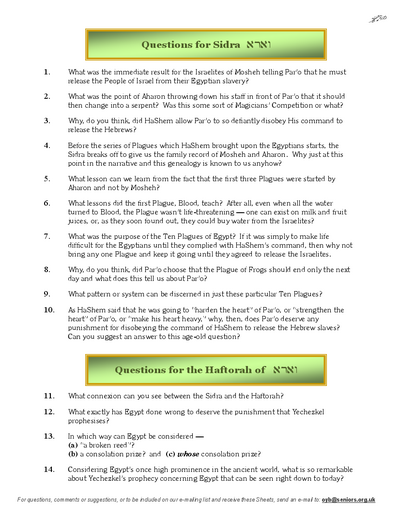
This week’s Haftorah is taken from Sefer Yechezkel, Chapter 28, verse 25 — Chapter 29, verse 21

1. The common theme of the Sidra and its Haftorah is the punishment of Egypt. But there are different reasons for that punishment. The Egypt of the Sidra was punished for defying the command of HaShem to let us go free and its punishment was the series of the Ten Plagues. On the other hand, the punishment of the Egypt in the Haftorah, approximately one thousand years later, was, once again, because of Egypt’s refusal to acknowledge that HaShem is the Sovereign of the world but also for Egypt’s deceitful conduct towards the Jewish People, which, though nowhere near as cruel as the Egypt of our slavery, nevertheless did help to bring about great harm to the Jewish People.

2. At the time of our Haftorah, the world’s political scene was dominated by the kingdom of Egypt and the growing world power of Babylon (roughly where Iraq and Iran are today). Babylon’s king, Nevuchadnetzar, had his greedy eyes on the strategically-placed Land of Israel. Indeed, it is because of the Land of Israel’s central position in the world that HaShem promised to Avrohom, Yitzchok and Yaakov that their children shall inhabit that land, for He wishes them to influence the whole of mankind, to teach everyone of the Sovereignty of HaShem. The relatively narrow strip of land that is Eretz Yisroel is in fact a bridge between the two land masses that we call today Africa and the countries of Europe. Furthermore, this really rather small land connects all the world for it forms the seaboard along the Mediterranean Sea (the word “Mediterranean” means “middle of the earth” and that’s what it is) and serves all that land which stretches all the way back to India and China. So, geographically, it is an important land, with much trade and commerce passing through and therefore the people who live there are ideally placed to influence the thinking and morals of all the nations of the world. That is our purpose and the purpose of our being given Eretz Yisroel. (See SIDRA OF THE WEEK: כי תבא)

3. But it is just because of its strategic importance that empire-builders have always wanted it and for exactly that reason that we have always needed HaShem’s protection from the invader and the conqueror. Thus, when we are loyal to HaShem and His Torah and conscientiously keep His Mitzvos, then our Land and our People come directly under HaShem’s protection. Even though we are encircled by enemies and covetous peoples, a veritable single sheep surrounded by seventy wolves, we are nevertheless safe under HaShem and we are living proof of HaShem and how we are His special covenanted People of the Torah. But when we turn away from HaShem and His Torah, then HaShem lets natural events and consequences take their course and conquerors and invaders threaten the peace of our land and its people. When that happens, two options present themselves. Our rulers can try to form allegiances with other local rulers and kings to fend off the threatened invaders. Or we can return to HaShem and His Torah and be protected directly by Him again.

4. Unfortunately, despite the warnings of our Nevi’im to return to HaShem and be protected by Him, the kings of Israel at the time of our Haftorah were persuaded to form alliances with the local kings to stand against Nevuchadnetzar. Even though Nevuchadnetzar had already started to lay siege to Yerushalaim and had declared his intentions of conquering Eretz Yisroel, the Jewish king thought that with the help of Egypt he could withstand the invader. For his part, Par’o Chofra, king of Egypt, coaxed the Jewish king to rely on his friendship and alliance and thus knowingly encouraged the Jewish People to ignore the warnings of the Nevi’im and to stand in rebellion against HaShem and His Torah. (Later, of course, Par’o returned to his country with his army and treacherously left the Jewish people to fall under the heel of Nevuchadnetzar who then destroyed the Beis HaMikdash and exiled the Jewish People to Babylon.)

PDF Preview