A Thought on Bitachon
Hashgacha Pratis | December 19, 2023
Print This Article
View Original PDF

A Thought on Bitachon

Hashgacha Pratis | December 31, 2025

A Thought on Bitachon

From the shiurim on Kav Hashgacha Pratis

The Chanukah Miracle Resulted from the Emunah of the Chashmona’im

Even though when we light Shabbos candles we say, “l’hadlik ner shel Shabbos,” when we light Chanukah candles we say, “l’hadlik ner Chanukah”; we don’t say “shel Chanukah.” In this way, the person making the brachah can keep in mind the initial letters of “l’hadlik ner Chanukah,” lamed nun ches, which make up the holy Name that refers to Hashem’s attribute of Notzer CHessed La’alafim. These letters are also the initial letters of the words from Tehillim (33:20), “Nafsheinu chiksa laHashem,” hinting out that the Chashmona’im were saved because they trusted in Hashem yisbarach and relied on Him for their yeshuah.

(Ben Ish Chai, hilchos Chanukah, Shanah Rishonah)

By the Work of His Hand, Not by the Work of His Mind

Rabi Yochanan said that a talmid chacham who learns l’Shem Shamayim and earns his living with his own hands will enjoy his olam hazeh and will receive a good reward in the World to Come (Tanna d’Vei Eliyahu). “Earns his living with his hands,” as I heard in the name of the Kotzker Rebbi, means that a person should act with honesty and should not allow business to occupy his mind all day, but should just do the minimum he needs to do to earn his living.

As Ramban says, all of Am Yisrael are required to work for a living, because many have tried to do as Rabi Shimon bar Yochai (who learned Torah rather than doing any sort of hishtadlus) but they were unsuccessful. What is the difference between one who trusts in Hashem and one who does not? You can tell the difference by how much emphasis each one puts on the means he is employing. A person who trusts in Hashem doesn’t place his trust in the type of business he has, but trusts in Hashem alone. He works to earn a living because this is his obligation. Since in Hashem’s Eyes it makes no difference whether the mode of hishtadlus is good or bad, the person does not need to rack his brain to make a parnassah. On the other hand, one who does not trust in Hashem but trusts only in the means he is employing is constantly worried about finding a better way to make more money.

(Rimzei Eish on Tanna d’Vei Eliyahu, Chapter 18)

Lack of Emunah, Lack of Attention

Rav Chaim of Volozhin zt”l described how a person from the natural world met a Jew from Luz, the city over which the angel of death held no power, and he told him that in our world people die, and it was clearly not easy for him to explain to him what it means to die. After he explained this to him, the man from Luz asked him, “If so, you certainly eat only grass. At the end of the day everyone dies, so what is the point of making a big deal over food?” The person explained that this is not the case; people eat well, and we do make a big deal over food. The man from Luz then asked him, “But certainly you must all live in simple burrows, because what is the point of building palaces when everyone dies in the end?” He responded that actually, people do build palaces. The man from Luz then asked, “Perhaps, then, everyone in your world wears sackcloth?” He answered that actually, people dress well, in the latest styles.

The man from Luz asked many other, similar questions and received the same surprising responses, again and again. Although on a simple level he certainly asked good questions, our instinctive reaction is to view him as a strange person. Why? Because we don’t pay attention to the true reality.

This clarifies what we always say: that one should not seek emunah in far-flung places, and not via signs and miracles, chalilah! Emunah, and all the greatest and highest things, are as simple as one plus one equals two, whereas lack of emunah and lack of understanding stem from a lack of attention to what is really taking place.

(Daas Torah, Rav Yerucham Levovitz ztk”l)
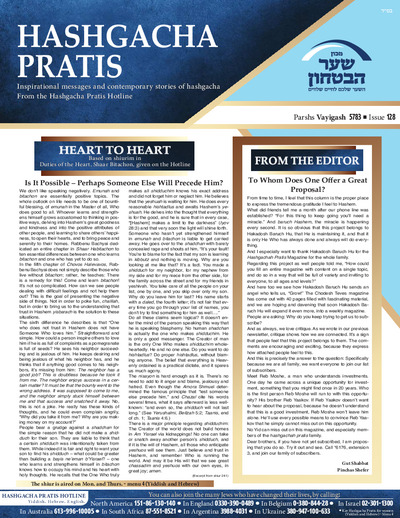
A Thought on Bitachon

From the shiurim on Kav Hashgacha Pratis

The Chanukah Miracle Resulted from the Emunah of the Chashmona’im

Even though when we light Shabbos candles we say, “l’hadlik ner shel Shabbos,” when we light Chanukah candles we say, “l’hadlik ner Chanukah”; we don’t say “shel Chanukah.” In this way, the person making the brachah can keep in mind the initial letters of “l’hadlik ner Chanukah,” lamed nun ches, which make up the holy Name that refers to Hashem’s attribute of Notzer CHessed La’alafim. These letters are also the initial letters of the words from Tehillim (33:20), “Nafsheinu chiksa laHashem,” hinting out that the Chashmona’im were saved because they trusted in Hashem yisbarach and relied on Him for their yeshuah.

(Ben Ish Chai, hilchos Chanukah, Shanah Rishonah)

By the Work of His Hand, Not by the Work of His Mind

Rabi Yochanan said that a talmid chacham who learns l’Shem Shamayim and earns his living with his own hands will enjoy his olam hazeh and will receive a good reward in the World to Come (Tanna d’Vei Eliyahu). “Earns his living with his hands,” as I heard in the name of the Kotzker Rebbi, means that a person should act with honesty and should not allow business to occupy his mind all day, but should just do the minimum he needs to do to earn his living.

As Ramban says, all of Am Yisrael are required to work for a living, because many have tried to do as Rabi Shimon bar Yochai (who learned Torah rather than doing any sort of hishtadlus) but they were unsuccessful. What is the difference between one who trusts in Hashem and one who does not? You can tell the difference by how much emphasis each one puts on the means he is employing. A person who trusts in Hashem doesn’t place his trust in the type of business he has, but trusts in Hashem alone. He works to earn a living because this is his obligation. Since in Hashem’s Eyes it makes no difference whether the mode of hishtadlus is good or bad, the person does not need to rack his brain to make a parnassah. On the other hand, one who does not trust in Hashem but trusts only in the means he is employing is constantly worried about finding a better way to make more money.

(Rimzei Eish on Tanna d’Vei Eliyahu, Chapter 18)

Lack of Emunah, Lack of Attention

Rav Chaim of Volozhin zt”l described how a person from the natural world met a Jew from Luz, the city over which the angel of death held no power, and he told him that in our world people die, and it was clearly not easy for him to explain to him what it means to die. After he explained this to him, the man from Luz asked him, “If so, you certainly eat only grass. At the end of the day everyone dies, so what is the point of making a big deal over food?” The person explained that this is not the case; people eat well, and we do make a big deal over food. The man from Luz then asked him, “But certainly you must all live in simple burrows, because what is the point of building palaces when everyone dies in the end?” He responded that actually, people do build palaces. The man from Luz then asked, “Perhaps, then, everyone in your world wears sackcloth?” He answered that actually, people dress well, in the latest styles.

The man from Luz asked many other, similar questions and received the same surprising responses, again and again. Although on a simple level he certainly asked good questions, our instinctive reaction is to view him as a strange person. Why? Because we don’t pay attention to the true reality.

This clarifies what we always say: that one should not seek emunah in far-flung places, and not via signs and miracles, chalilah! Emunah, and all the greatest and highest things, are as simple as one plus one equals two, whereas lack of emunah and lack of understanding stem from a lack of attention to what is really taking place.

(Daas Torah, Rav Yerucham Levovitz ztk”l)

PDF Preview