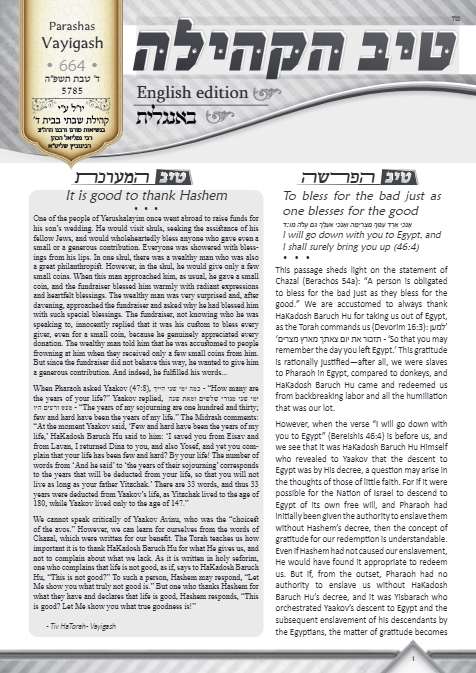
It is good to thank Hashem
One of the people of Yerushalayim once went abroad to raise funds for his son’s wedding. He would visit shuls, seeking the assistance of his fellow Jews, and would wholeheartedly bless anyone who gave even a small or a generous contribution. Everyone was showered with blessings from his lips. In one shul, there was a wealthy man who was also a great philanthropist. However, in the shul, he would give only a few small coins. When this man approached him, as usual, he gave a small coin, and the fundraiser blessed him warmly with radiant expressions and heartfelt blessings. The wealthy man was very surprised and, after davening, approached the fundraiser and asked why he had blessed him with such special blessings. The fundraiser, not knowing who he was speaking to, innocently replied that it was his custom to bless every giver, even for a small coin, because he genuinely appreciated every donation. The wealthy man told him that he was accustomed to people frowning at him when they received only a few small coins from him. But since the fundraiser did not behave this way, he wanted to give him a generous contribution. And indeed, he fulfilled his words...
When Pharaoh asked Yaakov (47:8), כמה ימי שני חייך - “How many are the years of your life?” Yaakov replied, ימי שני מגורי שלשים ומאת שנה מעט ורעים היו - “The years of my sojourning are one hundred and thirty; few and hard have been the years of my life.” The Midrash comments: “At the moment Yaakov said, ‘Few and hard have been the years of my life,’ HaKadosh Baruch Hu said to him: ‘I saved you from Eisav and from Lavan, I returned Dina to you, and also Yosef, and yet you complain that your life has been few and hard? By your life! The number of words from ‘And he said’ to ‘the years of their sojourning’ corresponds to the years that will be deducted from your life, so that you will not live as long as your father Yitzchak.’ There are 33 words, and thus 33 years were deducted from Yaakov’s life, as Yitzchak lived to the age of 180, while Yaakov lived only to the age of 147.”
We cannot speak critically of Yaakov Avinu, who was the “choicest of the avos.” However, we can learn for ourselves from the words of Chazal, which were written for our benefit. The Torah teaches us how important it is to thank HaKadosh Baruch Hu for what He gives us, and not to complain about what we lack. As it is written in holy seforim, one who complains that life is not good, as if, says to HaKadosh Baruch Hu, “This is not good?” To such a person, Hashem may respond, “Let Me show you what truly not good is.” But one who thanks Hashem for what they have and declares that life is good, Hashem responds, “This is good? Let Me show you what true goodness is!”
- Tiv HaTorah - Vayigash
Related Articles