Sidra of the Week Vayikra
Questions on the Sidra | March 19, 2024
Print This Article
View Original PDF

Sidra of the Week Vayikra

Questions on the Sidra | June 27, 2025

1. This week’s Sidra is the first Sidra of the third Book of the Torah. Whereas the first Sefer, רֵאשִׁית, tells of events from the beginning of Creation till our going down to Egypt (a time-span of over two thousand years) the second Sefer, שְׁמוֹת, tells of our time in Egypt and our Deliverance from there by הַקָּדוֹשׁ בָּרוּךְ הוּא. This third Sefer, וַיִּקְרָא, is comprised mainly of the laws that HaShem commanded us while we were in the Wilderness of Sinai on our way to Eretz Yisroel (a period of forty years) with some emphasis on the laws of the Mishkan and the Korbonos, the laws of Tum’oh and Taharoh and the laws pertaining to the Kohannim. This week’s Sidra begins with the Laws of Korbonos.

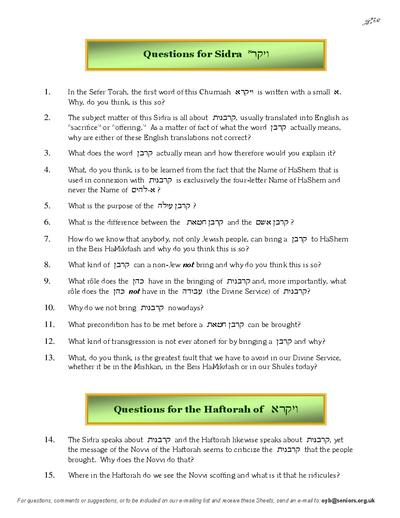
2. The word “Korbon” is commonly translated as “sacrifice” or “offering” but really it means neither of these. The word “Korbon” has as its basic meaning “to draw near” and that in fact is what the Korban is: it is a means of bringing one nearer to HaShem.

3. From the beginning of time, Man has expressed his thankfulness and homage to G-d by bringing Korbonos, in much the same way that the natural instinct in Man prompts him to pray to G-d for his needs. These feelings are so basic in the human being and so much a part of his nature that all human beings without exception, be they of any age and any culture, have always sought to find expression of their wanting to come closer to G-d. This instinct is deeply implanted by HaShem in human beings as in no other of His creatures, for it is only Man who was created by HaShem with the faculties to know his Creator and with the spiritual yearning to find fulfilment in coming closer to Him, for this is his purpose.

4. Of course, every good instinct can be smothered; every noble feeling can be defiled. Over the ages, men did allow their spiritual feelings to become polluted and misdirected, in some cultures so badly that they in fact became a barrier between Man and his Maker. It is these practices, originally prompted by genuine religious feelings but then grossly defiled and perverted almost beyond recognition of their noble origins (giving rise to idolatry and other such abominations) that the Torah utterly condemns. It is for this reason that the Torah reserves the most severe punishment (כרת) for the desecration of Korbonos and their proper procedure and practice, for the greater the potential good, the greater is the offence of its ruin. It is because HaShem wants our Divine Service of Korbonos to be perfect and unspoiled that He instructs us in the exact procedures and practices that are to be followed. That way, our Korbonos are indeed as “a sweet-smelling and pleasant fire-offering to HaShem” for we observe His instructions and obey His wishes.

5. Hardly anywhere else in the Written Torah is so much detail given in describing a Mitzvah as in the case of Korbonos. Of course, this detail is then explained and elaborated in the Oral Torah which was taught to us at the same time (although it was committed to writing only much later) but the very fact that this Mitzvah is taught at such length and in such detail in itself serves as an indication of the importance that we are to attach to understanding each and every component of the Mitzvah of Korbonos. For through these Laws we are to understand what it is that HaShem wants from us and how we are to come closer to Him in our everyday life, too. Every law, every detail, is to teach us something: the kind of animal that is brought as a particular Korbon; what parts are burned on the Altar; what parts are to be eaten and by whom; the procedure to be followed all the way through; other Korbonos (of flour, oil, etc.) and the libations, that is, the liquid component, prescribed for each Korbon — each and every detail is greatly symbolic of our total life’s work of obedience and service to HaShem.

6. There are several different types of Korban, and the first one in this Sidra is the Korban Olah. This Korban, which is the only one to be “completely burned-up” on the Great Altar, and thus symbolizes a complete giving-up of oneself to HaShem, is brought by a person who is negligent in his duties to HaShem. Through this Korban, he renews his dedication to HaShem and His Torah — he is “elevated” (this meaning is inherent in the word “Olah,” too) by bringing this Korban in the Mishkan of HaShem, the depository of His Torah (represented by the Two Tablets of the Testimony held in the Ark of the Covenant). And because the Mikdash is the world centre for all people seeking true spiritual attainment, non-Jews too are permitted to bring a Korban Olah.

7. The Torah never gives the rich an advantage over the poor in the performance of a Mitzvah, and if a Korban was always to be a large, expensive animal, poor people would be excluded from bringing a Korban. The Torah therefore commands various kinds of Korban Olah: he who can afford it, can bring for his Korban a bull; if this is beyond his means, he brings a sheep or goat; if this too is beyond his reach, he brings a pigeon as a Korban Olah; and the poorest of the poor, unable to afford even a pigeon, brings for his Korban Olah a Korban Mincha consisting of a measure of fine flour, some olive oil and a little frankincense (a sweet-smelling resin). Our Chachommim, of blessed memory, point out that the animals and birds commanded to be brought for Korbonos are only those which are ordinarily harmless and defenceless and do not pursue or attack other animals. This is to teach that HaShem rejects those who harm others but He favours those that are pursued and victimized. They point out further that HaShem’s expression of satisfaction with the first three kinds of Korban Olah is the same, for the pigeon brought by the poor man is as acceptable to HaShem as the bull or sheep brought by the wealthier man. Yet the expression of HaShem’s satisfaction with the Korban Mincha of the poorest of the poor is far stronger, because generally the poor man’s Korban means more to him than the rich man’s means to him, and HaShem looks to the heart.

8. If a person mistakenly committed one of the more serious transgressions of the Torah, he must bring a Korban Chattos. The idea behind this Korban is similar to that behind the Korban Olah: the confession made before HaShem when the Korban is brought and the whole process of the Korban helps the person to regain the standard he had before he committed the sin. (It follows, therefore, that if a person sinks so low as to deliberately transgress the Word of HaShem, the lessons of the Korbonos will have no effect on him and such a person cannot bring any Korbon. Repentance in the heart, not the bringing of Korbonos, is what achieves atonement before HaShem.) For the less serious sin, committed by mistake, no Korbon is brought, for the Torah recognizes that basically every person is good and wishes to comply with the Will of HaShem. Such lapses as do occur will be corrected even without the powerful emotion that is the result of bringing a Korbon.

9. There is another kind of Korban, brought by a person who admits to having committed a dishonest act after having previously denied it and sworn falsely. Such a person, too, is given the opportunity to place himself again under the Authority of HaShem, by means of a Korban Oshom. A different Korban Oshom, called the Korban Oshom for the Uncertain Sin, is brought by the person who is in doubt whether in fact he transgressed one of the Mitzvos for which a Korban Chattos is brought if he was sure of his offence. (The fact that this Korbon is a more costly one than a regular Korban Chattos helps to bring home to the offender the need for repentance for his lapse, which, because of the uncertainty of his transgression, is subconsciously treated — wrongly — more lightly.) If it should transpire that the sin was indeed committed, he then brings a Korban Chattos, too.

10. Various other Korbonos are enumerated in the Torah, and some are in this week’s Sidra: some are brought on behalf of the entire Jewish Nation; some are brought by individuals; some are brought at specific times; some are brought for commission or omission of deeds; some are voluntary; some are obligatory. Some Korbonos are classed by the Torah as “holy,” some are “most holy”; some Korbonos are not eaten at all but are completely burned on the Altar, whilst some parts of others are eaten “in the Presence of HaShem,” that is, within the precincts of the Holy City or of the Mikdash respectively (and within various specified time limits) by the Kohannim who officiated, or by the person who brings the Korbon and his family and friends. Each and every one of the laws and procedures of each kind of Korbon is commanded by HaShem to teach us a particular lesson, but all together the Korbonos add up to the great exhortation of the Torah and which can, at the risk of over-simplification, be stated as follows: Every human being is made up of two parts, the physical and the spiritual. Physically, Man is not very different from the animal. It is Man’s Divine soul, evidenced by his intellect and appreciation of right and wrong, that raises him above the animal. When a person loses sight of his high calling as a servant of HaShem, and thus transgresses His Torah (or indeed, so that Man should not come to forget his special place in HaShem’s plan) HaShem commands that Man should bring a Korbon, representing the physical or material element in Man, to subjugate himself once again totally, body and soul, to the wishes of HaShem.

For the explanation of the Haftorah of Sidra ויקרא please go to HAFTORAHS.
1. This week’s Sidra is the first Sidra of the third Book of the Torah. Whereas the first Sefer, רֵאשִׁית, tells of events from the beginning of Creation till our going down to Egypt (a time-span of over two thousand years) the second Sefer, שְׁמוֹת, tells of our time in Egypt and our Deliverance from there by הַקָּדוֹשׁ בָּרוּךְ הוּא. This third Sefer, וַיִּקְרָא, is comprised mainly of the laws that HaShem commanded us while we were in the Wilderness of Sinai on our way to Eretz Yisroel (a period of forty years) with some emphasis on the laws of the Mishkan and the Korbonos, the laws of Tum’oh and Taharoh and the laws pertaining to the Kohannim. This week’s Sidra begins with the Laws of Korbonos.

2. The word “Korbon” is commonly translated as “sacrifice” or “offering” but really it means neither of these. The word “Korbon” has as its basic meaning “to draw near” and that in fact is what the Korban is: it is a means of bringing one nearer to HaShem.

3. From the beginning of time, Man has expressed his thankfulness and homage to G-d by bringing Korbonos, in much the same way that the natural instinct in Man prompts him to pray to G-d for his needs. These feelings are so basic in the human being and so much a part of his nature that all human beings without exception, be they of any age and any culture, have always sought to find expression of their wanting to come closer to G-d. This instinct is deeply implanted by HaShem in human beings as in no other of His creatures, for it is only Man who was created by HaShem with the faculties to know his Creator and with the spiritual yearning to find fulfilment in coming closer to Him, for this is his purpose.

4. Of course, every good instinct can be smothered; every noble feeling can be defiled. Over the ages, men did allow their spiritual feelings to become polluted and misdirected, in some cultures so badly that they in fact became a barrier between Man and his Maker. It is these practices, originally prompted by genuine religious feelings but then grossly defiled and perverted almost beyond recognition of their noble origins (giving rise to idolatry and other such abominations) that the Torah utterly condemns. It is for this reason that the Torah reserves the most severe punishment (כרת) for the desecration of Korbonos and their proper procedure and practice, for the greater the potential good, the greater is the offence of its ruin. It is because HaShem wants our Divine Service of Korbonos to be perfect and unspoiled that He instructs us in the exact procedures and practices that are to be followed. That way, our Korbonos are indeed as “a sweet-smelling and pleasant fire-offering to HaShem” for we observe His instructions and obey His wishes.

5. Hardly anywhere else in the Written Torah is so much detail given in describing a Mitzvah as in the case of Korbonos. Of course, this detail is then explained and elaborated in the Oral Torah which was taught to us at the same time (although it was committed to writing only much later) but the very fact that this Mitzvah is taught at such length and in such detail in itself serves as an indication of the importance that we are to attach to understanding each and every component of the Mitzvah of Korbonos. For through these Laws we are to understand what it is that HaShem wants from us and how we are to come closer to Him in our everyday life, too. Every law, every detail, is to teach us something: the kind of animal that is brought as a particular Korbon; what parts are burned on the Altar; what parts are to be eaten and by whom; the procedure to be followed all the way through; other Korbonos (of flour, oil, etc.) and the libations, that is, the liquid component, prescribed for each Korbon — each and every detail is greatly symbolic of our total life’s work of obedience and service to HaShem.

6. There are several different types of Korban, and the first one in this Sidra is the Korban Olah. This Korban, which is the only one to be “completely burned-up” on the Great Altar, and thus symbolizes a complete giving-up of oneself to HaShem, is brought by a person who is negligent in his duties to HaShem. Through this Korban, he renews his dedication to HaShem and His Torah — he is “elevated” (this meaning is inherent in the word “Olah,” too) by bringing this Korban in the Mishkan of HaShem, the depository of His Torah (represented by the Two Tablets of the Testimony held in the Ark of the Covenant). And because the Mikdash is the world centre for all people seeking true spiritual attainment, non-Jews too are permitted to bring a Korban Olah.

7. The Torah never gives the rich an advantage over the poor in the performance of a Mitzvah, and if a Korban was always to be a large, expensive animal, poor people would be excluded from bringing a Korban. The Torah therefore commands various kinds of Korban Olah: he who can afford it, can bring for his Korban a bull; if this is beyond his means, he brings a sheep or goat; if this too is beyond his reach, he brings a pigeon as a Korban Olah; and the poorest of the poor, unable to afford even a pigeon, brings for his Korban Olah a Korban Mincha consisting of a measure of fine flour, some olive oil and a little frankincense (a sweet-smelling resin). Our Chachommim, of blessed memory, point out that the animals and birds commanded to be brought for Korbonos are only those which are ordinarily harmless and defenceless and do not pursue or attack other animals. This is to teach that HaShem rejects those who harm others but He favours those that are pursued and victimized. They point out further that HaShem’s expression of satisfaction with the first three kinds of Korban Olah is the same, for the pigeon brought by the poor man is as acceptable to HaShem as the bull or sheep brought by the wealthier man. Yet the expression of HaShem’s satisfaction with the Korban Mincha of the poorest of the poor is far stronger, because generally the poor man’s Korban means more to him than the rich man’s means to him, and HaShem looks to the heart.

8. If a person mistakenly committed one of the more serious transgressions of the Torah, he must bring a Korban Chattos. The idea behind this Korban is similar to that behind the Korban Olah: the confession made before HaShem when the Korban is brought and the whole process of the Korban helps the person to regain the standard he had before he committed the sin. (It follows, therefore, that if a person sinks so low as to deliberately transgress the Word of HaShem, the lessons of the Korbonos will have no effect on him and such a person cannot bring any Korbon. Repentance in the heart, not the bringing of Korbonos, is what achieves atonement before HaShem.) For the less serious sin, committed by mistake, no Korbon is brought, for the Torah recognizes that basically every person is good and wishes to comply with the Will of HaShem. Such lapses as do occur will be corrected even without the powerful emotion that is the result of bringing a Korbon.

9. There is another kind of Korban, brought by a person who admits to having committed a dishonest act after having previously denied it and sworn falsely. Such a person, too, is given the opportunity to place himself again under the Authority of HaShem, by means of a Korban Oshom. A different Korban Oshom, called the Korban Oshom for the Uncertain Sin, is brought by the person who is in doubt whether in fact he transgressed one of the Mitzvos for which a Korban Chattos is brought if he was sure of his offence. (The fact that this Korbon is a more costly one than a regular Korban Chattos helps to bring home to the offender the need for repentance for his lapse, which, because of the uncertainty of his transgression, is subconsciously treated — wrongly — more lightly.) If it should transpire that the sin was indeed committed, he then brings a Korban Chattos, too.

10. Various other Korbonos are enumerated in the Torah, and some are in this week’s Sidra: some are brought on behalf of the entire Jewish Nation; some are brought by individuals; some are brought at specific times; some are brought for commission or omission of deeds; some are voluntary; some are obligatory. Some Korbonos are classed by the Torah as “holy,” some are “most holy”; some Korbonos are not eaten at all but are completely burned on the Altar, whilst some parts of others are eaten “in the Presence of HaShem,” that is, within the precincts of the Holy City or of the Mikdash respectively (and within various specified time limits) by the Kohannim who officiated, or by the person who brings the Korbon and his family and friends. Each and every one of the laws and procedures of each kind of Korbon is commanded by HaShem to teach us a particular lesson, but all together the Korbonos add up to the great exhortation of the Torah and which can, at the risk of over-simplification, be stated as follows: Every human being is made up of two parts, the physical and the spiritual. Physically, Man is not very different from the animal. It is Man’s Divine soul, evidenced by his intellect and appreciation of right and wrong, that raises him above the animal. When a person loses sight of his high calling as a servant of HaShem, and thus transgresses His Torah (or indeed, so that Man should not come to forget his special place in HaShem’s plan) HaShem commands that Man should bring a Korbon, representing the physical or material element in Man, to subjugate himself once again totally, body and soul, to the wishes of HaShem.

For the explanation of the Haftorah of Sidra ויקרא please go to HAFTORAHS.

PDF Preview