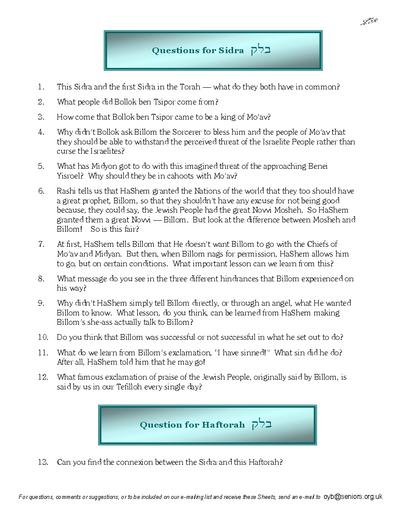
Haftorah of Sidra Balak
This week’s Haftorah is from Sefer Michoh, (one of the shorter Books of the Prophets making up The Twelve) from Chapter 5, verse 6 till Chapter 6 verse 8.
1. Once again, the connexion between the Sidra and the Haftorah is rather tenuous. It is simply that in the course of his speech, the prophet Michoh mentions the events of this week’s Sidra as an example of how HaShem has always protected His People from their adversaries. Another connexion is the promise that HaShem will get rid of magic and wizardry from amongst the Jewish People, which calls to mind that malevolent sorcerer, Billom, a central figure in the Sidra.
2. The Novvi Michoh, a contemporary of Yeshayohu, lived in the time of the exile of the Northern Kingdom of Israel. This exile started with the attack of Tiglas-Pilesser against the Northern Kingdom of Israel and ended with the carrying-off of the Ten Tribes as exiles by Shalmanezer. (Both of these were kings of Ashur.) Michoh was a champion of the poorer people and often lambasted the rich landowning city-dwellers for being heartless. He condemned them for exploiting the destitute and defenceless workers who toiled hard to eke out a living from the soil. His message from HaShem to the wealthy people of Yerushalaim and the Southern Kingdom of Yehudah was the warning that if they will not better their ways they too will suffer the same fate as the people of the Northern Kingdom. They too will find themselves exiled just like the people and king of the Northern Kingdom has been exiled.
3. But besides being a message to the Jewish people of his time and for that time, the message of Michoh that is our Haftorah speaks also of events far into the future. The time will come, says Michoh, when HaShem will gather-in the exiles of the Jewish People. That is a given. But our exile meanwhile is not intended only as a punishment. Our exile amongst the Nations of the world also serves HaShem’s purpose, that is, to spread the knowledge of HaShem amongst the Nations of the world and to make known to them the morality and social justice that will, in peace and brotherliness, elevate all the families of the world. The Jewish People, the descendants of Avrohom and carrying within them his high ideals and now dispersed amongst the nations, will bring the benefits of these great teachings to those nations and, says the Novvi, “will be like the refreshing dew and the invigorating rain-showers” upon a parched earth.
4. Even in exile, the Jewish People will defy all the rules of history and will never disappear. And when the time comes for our redemption from exile, there will be no need for war-horses or chariots or fortresses or fortified cities. Indeed, there will be no need to resort to any unnatural powers or magic or sorcery to defend ourselves, for HaShem Himself protects us. We for our part will renounce all idolworship and stop placing our trust in our own power and will instead rely solely on HaShem. He will repay those nations who dealt with us kindly with kindness and those that tormented us He will punish.
5. Michoh tells us to look back over our history and see how HaShem has protected us and indeed how it has ever been thus. In a grand proclamation, Michoh tells the ancient hills and timeless mountains to hear HaShem’s challenge that He throws down to those of the Jewish People who deserted Him: “See how much I have done for you and yet have made so few demands upon you! I took you out from the land of Egypt, the house of slavery. I sent you Mosheh to lead you all and teach you the Torah, and Aharon to bless you and help you to achieve atonement through the Divine Service of the Sanctuary and Miriam to teach the women and I protected you way back then from the evil sorcerer Billom. (This is the link with this week’s Sidra, mentioned above.) And so, too, throughout the generations, I always granted you great Torah leaders and I protected you (often way beyond the protection that you merited) from those that would do you harm.”
6. Yet, says Michoh, HaShem does not demand great and expensive sacrifices. On the contrary, HaShem asks scornfully: “Do I want your thousands of rams or numerous libations of oil and wine? Do I want your firstborn children as a sacrifice to atone for your sins or the sacrifice of any children at all to pardon your waywardness?” Not at all and to the contrary! If the heart and intentions of the person are not genuinely good, then Korbonnos are worse than nothing for they become part of the charade and the hypocrisy. HaShem has told us long ago what he wants from us — in any case it is for our own good, too — and it is the same as He has told us ever since we became His People and received His Torah, says the Novvi.
7. Here, when he says that, “He has told us long ago,” Michoh refers to the very beginning of our history and that episode where HaShem Himself declares in His Torah clearly and unambiguously exactly why He chose our forefather Avrohom. HaShem expresses it thus: “I love Avrohom, for I know that he will teach and train his children and his followers that they shall keep to the way of G-d ...” And what is this “way of G-d”? Is it “to be religious”? (Whatever that is!) Is it, perhaps, to offer up many sacrifices? Maybe it’s to retire from this world and be a recluse, “contemplating the Divine”?
8. It is none of these, says Michoh. And we don’t need to guess, either. HaShem Himself tells us what to “follow the way of G-d” means. “... that they shall keep to the way of G-d, namely, to do righteousness and justice.” And this is the message that is proclaimed by Michoh (and is the concluding Possuk of our Haftorah): “HaShem has told you long ago, Man, what it is that He wants from you! It is that you shall do justice and love kindness and go about your lives humbly, that is, without ostentation or exhibition, with HaShem your G-d always in your minds and hearts.”