Parshas Bereshis Questions and Answers
Parsha Pages Youth | October 09, 2023
Parshas Bereshis
Questions
- Which person in the book of Genesis (Breishit) is actually referred to as "Reishit"?
- Aside from the first day of creation, where else in the book of Genesis is the phrase "Yom Echad" – “one day” used? (2 answers)
- The sun and the moon are not called by their names with regard to their creation, but are referred to as “luminaries” (Me’orot). Where in the book of Genesis are the words sun and moon found in the same verse?
- The “great sea-creatures” (Taninin), were created on the fifth day (1:21). Where else in the Torah is a “Tanin” mentioned?
- Which is the only letter of the alphabet that does not appear in the account of creation of the first chapter?
- The snake tricked Eve (Chava) into eating from the fruit of the Tree of Knowledge. Where else in the Torah does a snake appear? (4 answers)
- Which adjective is used to describe Adam and Eve as well as the snake?
- Although fruit is mentioned several times in this Parsha, which is the only fruit mentioned by name?
- What was found in the Holy of Holies of the Tabernacle, and also placed near the Garden of Eden?
- Which four women are mentioned in this Parsha?
- Which grandfather and grandson from this Parsha appear in the text of the weekday Amidah?
- In this Parsha, who named a city after someone? Who else in the Torah named a city after a person? (4 answers)
Answers
- In Genesis 49:3, Yaakov refers to Reuven his first-born as Reishit Oni – “my initial vigor.”
- In Genesis 27:45, Rivka worries that her two sons will die on "Yom Echad" – “one day.” In Genesis 33:13, Yaakov excuses himself from traveling with Esav by stating that if he does, the children and sheep will be too pressured for “one day.”
- In Genesis 37:9, the sun and the moon appear in the dream of Yosef.
- In Exodus 7:10-11, the staff of Aaron miraculously turns into a Tanin. (There, however, Rashi translates Tanin as a snake.)
- The letter Samech does not appear until Genesis 2:11.
- In Genesis 49:17, in Yaakov’s blessing to his son Dan, a snake is mentioned. In Exodus 4:3, at the burning bush, the staff of Moses turns into a snake. In Numbers 21:7, when the snakes bite the Jews, Moses fashions a copper snake. In Deut. 8:15, Hashem describes how He protected the Jews in the desert from snakes.
- The adjective “arum" describes all three. Adam and Eve are described as “arumim” – “naked” (Genesis 2:25). The snake is also called "arum," although in that context it refers to slyness (Genesis 3:1).
- The fig is the only specifically named fruit in the Parsha (Genesis 3:7). Its leaves are used by Adam and Eve to cover themselves.
- The "Keruvim" (Cherubs) exist in both places. In the Tabernacle they are the golden figures that rest upon the Ark cover (Exodus 25:18). In our Parsha they protect the path to the Tree of Life (Genesis 3:24).
- The women found in the Parsha are: Eve, the two wives of Lemach (Genesis 4:19) and Na’ama, the sister of Tuval-Kayin (Genesis 4:22).
- Adam and his grandson Enosh (Genesis 5:3) appear in the blessing of אַתָּה חוֹנֵן לְאָּדָּם דַעַת, וּמְלַמֵד לֶאֱנוֹשׁ בִּינָּה, where their names are used as synonyms for mankind.
- Kayin named a city after his son Chanoch (4:17). In Numbers 32:41-42, Yair Ben Menasheh and Novach each named a city after themselves. It is also possible that the city of Shchem is named after the person of the same name (Genesis 33:18-19).
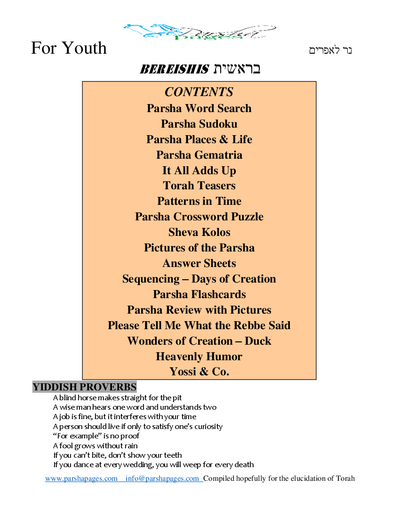
View The Full Article (PDF)
Related Articles

Parshas Bereshis Selections
Parsha Pages • Bereishis

In the Beginning Parsha Pizzazz
Parsha Pages Youth • Bereishis
Parsha Flashcards Bereshis
Parsha Pages Youth • Bereishis

Sheva Kolos Seven Questions and Answers for Seven Aliyos
Parsha Pages Youth • Bereishis

Patterns in Time
Parsha Pages Youth • Bereishis