The Call of the Hero
L’Chaim | October 28, 2025
Print This Article
View Original PDF

The Call of the Hero

L’Chaim | December 10, 2025

This week's Torah portion, Bo, speaks of the last three plagues visited on Egypt, and of the Jewish People's long-awaited departure from there. It begins with G-d's command to Moses that he go to Pharaoh, king of Egypt, to warn him of the impending plague of locusts. G-d, however, states that Pharaoh will not heed the warning: "For I have hardened his heart...in order that you tell in the ears of your son and your son's son that which I have wrought in Egypt."

We learn from this that the locusts did not come as a punishment for Pharaoh's refusal to heed the warning; G-d had hardened his heart so that he would be unable to agree to free the Jews. But if such is the case, isn't it unjust for G-d to punish Pharaoh with a plague, when G-d Himself prevented him from acceding to Moses' demand?

Our commentators explain that during the first five plagues Pharaoh had free will to decide his actions, and he could have permitted the Jews to leave. It was only after Pharaoh demonstrated his wickedness and rebelled against G-d--"Who is G-d that I should listen to His voice?"--that his free will was taken away. This punishment clearly fit the crime: Pharaoh questioned G-d's authority and boasted of his own might, so he was shown that he did not even have the power to make his own decisions. Pharaoh was thus fully subjugated to the will of G-d.

Furthermore, Pharaoh's behavior during the plague of locusts underscored his impotence. When even his servants begged him to free the Jews--"Let the people go so that they can serve their G-d. Do you not yet know that Egypt is lost?"--Pharaoh immediately agreed and declared to Moses and Aaron, "Go worship your G-d." But at that very instant G-d hardened his heart and Pharaoh was forced to renege on his promise.

Even with this explanation we are still left with a philosophical problem. Why did Moses and Aaron have to go through the motions of issuing a formal warning if they knew that there was no chance that Pharaoh would agree to their request?

It is explained in the book of Tanya, the central work of Chasidic philosophy, that even a person who is so sunken into evil ways and so deplorable that "he is not provided with a means to do teshuva (repent)," even he can overcome and find his way back to righteousness. Even the most corrupt and abominable sinner can return to G-d.

If Pharaoh, totally self-centered, wicked and deprived of his free will could have prevented the final plagues from befalling his nation by exerting supreme effort to overcome the hardening of his heart, how much more so is it possible for every Jew to overcome his negative character traits and do teshuva.

A Jew's G-dly soul is termed "an actual piece of G-d," and is in his possession always, for the Jewish soul remains faithful to G-d even if the body commits a sin. A Jew always has the power to do teshuva, to return to G-d and live in harmony with his true essence. G-d awaits the return of every single Jew, for he can only sin externally, as his internal nature is untouched and holy.

Adapted from the works of the Lubavitcher Rebbe.
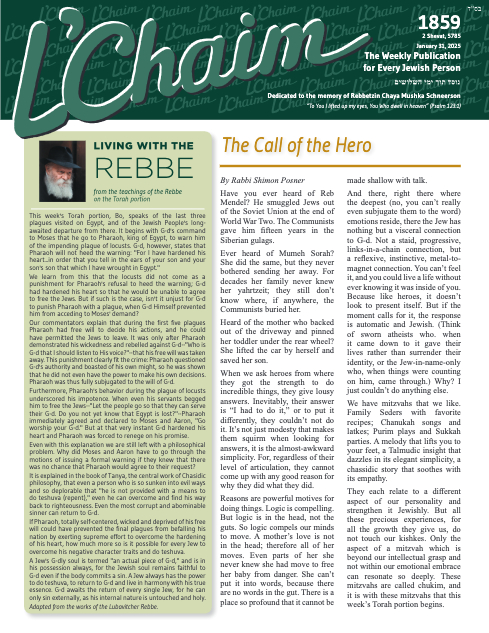
This week's Torah portion, Bo, speaks of the last three plagues visited on Egypt, and of the Jewish People's long-awaited departure from there. It begins with G-d's command to Moses that he go to Pharaoh, king of Egypt, to warn him of the impending plague of locusts. G-d, however, states that Pharaoh will not heed the warning: "For I have hardened his heart...in order that you tell in the ears of your son and your son's son that which I have wrought in Egypt."

We learn from this that the locusts did not come as a punishment for Pharaoh's refusal to heed the warning; G-d had hardened his heart so that he would be unable to agree to free the Jews. But if such is the case, isn't it unjust for G-d to punish Pharaoh with a plague, when G-d Himself prevented him from acceding to Moses' demand?

Our commentators explain that during the first five plagues Pharaoh had free will to decide his actions, and he could have permitted the Jews to leave. It was only after Pharaoh demonstrated his wickedness and rebelled against G-d--"Who is G-d that I should listen to His voice?"--that his free will was taken away. This punishment clearly fit the crime: Pharaoh questioned G-d's authority and boasted of his own might, so he was shown that he did not even have the power to make his own decisions. Pharaoh was thus fully subjugated to the will of G-d.

Furthermore, Pharaoh's behavior during the plague of locusts underscored his impotence. When even his servants begged him to free the Jews--"Let the people go so that they can serve their G-d. Do you not yet know that Egypt is lost?"--Pharaoh immediately agreed and declared to Moses and Aaron, "Go worship your G-d." But at that very instant G-d hardened his heart and Pharaoh was forced to renege on his promise.

Even with this explanation we are still left with a philosophical problem. Why did Moses and Aaron have to go through the motions of issuing a formal warning if they knew that there was no chance that Pharaoh would agree to their request?

It is explained in the book of Tanya, the central work of Chasidic philosophy, that even a person who is so sunken into evil ways and so deplorable that "he is not provided with a means to do teshuva (repent)," even he can overcome and find his way back to righteousness. Even the most corrupt and abominable sinner can return to G-d.

If Pharaoh, totally self-centered, wicked and deprived of his free will could have prevented the final plagues from befalling his nation by exerting supreme effort to overcome the hardening of his heart, how much more so is it possible for every Jew to overcome his negative character traits and do teshuva.

A Jew's G-dly soul is termed "an actual piece of G-d," and is in his possession always, for the Jewish soul remains faithful to G-d even if the body commits a sin. A Jew always has the power to do teshuva, to return to G-d and live in harmony with his true essence. G-d awaits the return of every single Jew, for he can only sin externally, as his internal nature is untouched and holy.

Adapted from the works of the Lubavitcher Rebbe.

PDF Preview