Medrash vs. the Simple Explanation: Stages of Divine Service
Medrash vs. the simple explanation
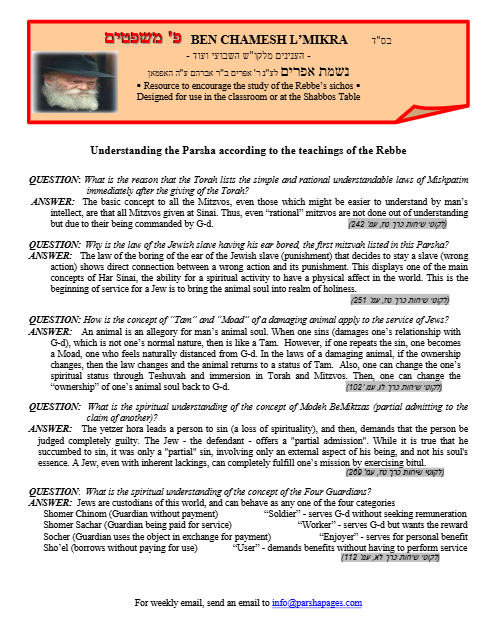
As was pointed out above, there is a difference between Rashi’s understanding of when the laws of mishpatim were taught and that of the other opinion brought in the Medrash. Rashi explained that these laws were instructed after the giving of the Torah, while the variant view in the Medrash maintains that these laws were taught prior to the giving of the Torah.
According to the above explanation concerning faith and logic, we can understand that from a deeper perspective, they are both in the right.
Rashi:
When a person is in the initial stages of serving G-d—expressed in the simple learning of the Torah as taught by Rashi—he does not yet have an appreciation for G-dliness. He does not yet comprehend G-dliness, nor does he possess a love or fear of G-d. At this point in one’s service of G-d, the individual cannot rely on his reasoning alone, as he is still very much under the dominion of the natural proclivities of the animalistic soul and will not come to the truth through his own deductions.
At this stage must be the realization that these rational laws as well were given at Sinai, and his understanding and fulfillment of them must be just as the Ten Commandments heard at Sinai. He must approach these laws in the way that they too were given with the tumultuous din of the Sinai revelation, and allow himself to be nullified toward them. He should not rely on his own identity to serve G-d, but should instead, relinquish his personal understanding to the will of the Almighty.
This idea comes into expression in the individual’s personal service of G-d through initially employing absolute humility toward the Almighty in order to subdue his animal soul. The Talmud states the following:
Text 12 A man should always incite the good impulse [in his soul] to fight against the evil impulse. For it is written: “Tremble and sin not.” Talmud, Berachos 5a
When a person overwhelms their natural impulses with the fear of the Almighty, this causes their animalistic soul to be nullified and keeps it in check. This act of nullifying the animal soul, however, is only necessary in one’s initial steps in their service of G-d, when they are still very much under the influence of their natural proclivities.
Medrash:
When a person though, has advanced in their service, and they have attained a level where they love and fear the Almighty and grasp G-dly concepts with their mind, this manner of service is no longer adequate. At this stage, rather than serving G-d from a lack of personal identity and a sense of subjugation towards His will, he should serve G-d because he understands that he must do so with his own rationale.
At such a stage, it is important to stress, as brought in the Medrash that these laws are logically understood and were given prior to the giving of the Torah, rather than stressing that they were given with the tumult of Sinai. Although according to the Medrash as well, the parsha of Yisro prefaces these rational laws, this is because a person must still have faith in G-d throughout his service, in order to keep him on the proper path. However, this is only the preface to the mishpatim. The laws themselves must be fulfilled through one’s own comprehension and the individual must thereby connect and become one with the Divine.