Every Day Should Be in Your Eyes as If It Were a New Experience
למודי משה | January 05, 2026
Print This Article
View Original PDF

Every Day Should Be in Your Eyes as If It Were a New Experience

למודי משה | January 09, 2026

In Parshas Shoftim, the Torah introduces us to the concept of a Jewish Monarchy. “When you come to the land that Hashem your G-d gives you, and possess it and settle in it, and you will say ‘I will set a king over myself, like all the nations that are around me.’” (Devorim 17:14). The Torah says, “Yes you are allowed to establish a monarchy. It is a mitzvah to have a king.”

However, there are restrictions: He may not have an excessive number of wives. He may not have too many horses. He should not take too much silver and gold for himself. And there are also positive commandments: “And it shall be when he sits on the throne of his kingdom, he shall write for himself two copies of this Torah in a scroll from before the Kohanim, the Levites” (Devorim 17:18). Every Jew must write a Sefer Torah. The king needs to write a second Sefer Torah which he keeps with himself at all times.

The Torah introduces the mitzvah to write this (second) Sefer Torah with the expression “And it shall be when he sits (k’shivto) on the throne of his kingdom.” The Medrash in Esther Rabbah makes a very interesting comment. There are two ways of saying “And when he will sit on his throne.” It could say “v’haya k’shivto” or it could say “v’haya b’shivto.” The Medrash makes a distinction regarding the implications of each term. By the nations of the world, the pasuk says, “k‘sheves haMelech Achashverosh al kisei malchuso...” (Esther 1:2) using a letter “chaf” as the prefix. However, when we speak about Jewish kings in the Book of Shoftim (11:26), the pasuk says “b‘sheves Yisroel...” using the letter “beis” as the prefix. The Gemara explains the distinction: By the nations of the world, the “chaf” is used because their monarchies are not permanent. By kings of the Jewish nation, as long as there was a Klal Yisrael, the monarchy remained. Therefore, the prefix “beis” is used, which has a connotation of a permanent monarchy.

If that is the case, this pasuk in Parshas Shoftim presents a problem. It is speaking about a Jewish king and yet it uses the prefix “chof” – v’haya k’shivto al kisei mamlachto! This seems to violate the rule mentioned in Esther Rabbah.

I saw a thought in the name of the Gerrer Rebbe, the Chiddushei HaRim, and I saw a similar thought in the name of the Techeiles Mordechai from Rav Sholom Mordechai HaKohen Schwadron (the Brizhaner Rav). The reason the Torah uses the expression “And it will be k‘shivto...” here is because the Torah is speaking about the initial ascension of the Jewish king onto his throne. Normally, when a king first assumes his throne, he is all inspired and “pumped” to do good for the people. He wants to make sure the people are taken care of. He wants to make sure to improve the economy. He wants to make sure that human rights are preserved in his country. All the sincere and idealistic ideas of good government are always present when one starts something. Every president starts his administration with these grand ideas and grand plans to provide “a chicken in every pot and two cars in every garage and universal health care” etc., etc., etc.

Those plans are made “v’haya k’shivto...” (when he first ascends the throne). But we all know that with the passage of time, it rapidly becomes “same old, same old.” People become jaded; they become turned off; they get cynical. People sort of devolve into a run of the mill, go-through-the-motions type of administration.

The challenge always is for a king to maintain throughout his monarchy that same feeling of freshness, enthusiasm, and humility that he had the day he sat on the throne for the first time. This is what the Torah wants to hint at here, says the Brizhaner Rav. All the plans and good intentions that a king has when he assumes the throne (k’shivto al kisei malchuso) should remain with him for the rest of his reign.

This idea is a very beautiful vort to say at a sheva berachos. At a sheva berachos, the chosson and kallah are in their first week of marriage. They are so sensitive and so caring and so loving towards each other. They each have the greatest of intentions to make this a perfect marriage. But unfortunately, as we know, like with everything else in life – things do not remain the way they were at the start of an endeavor. Honeymoons are called honeymoons because they only last for a certain amount of time, unfortunately.

A chosson is compared to a king. That enthusiasm and that idealism and that commitment to be a good husband and to take care of the spouse and to respect and honor her should remain constant throughout the marriage as it was “k’shivto...” when he first ascended to the role of a chosson (who is compared to a king).”

Rav Pam once offered a beautiful thought. We say “v’erastich lee l’olam” (Hoshea 2:21) (And I will betroth you to me forever). Erusin [betrothal] is a temporary stage. It is the period between kiddushin [halachic engagement] and nisuin [halachic marriage]. In Talmudic times, it lasted for 6 to 12 months, but it was always meant to be a temporary situation. So, what then, asked Rav Pam, does the pasuk mean when it says, “I will betroth you to me forever”? If it is forever, it is not eirusin and if it is eirusin it is not forever?

Rav Pam said the same type of concept. When someone goes ahead and makes eirusin, he has all the good intentions and the love and compassion in the world, but it is only “eirusin” – a temporary stage. However, that type of “I will betroth you to me” should really be forever. (R’ Frand)
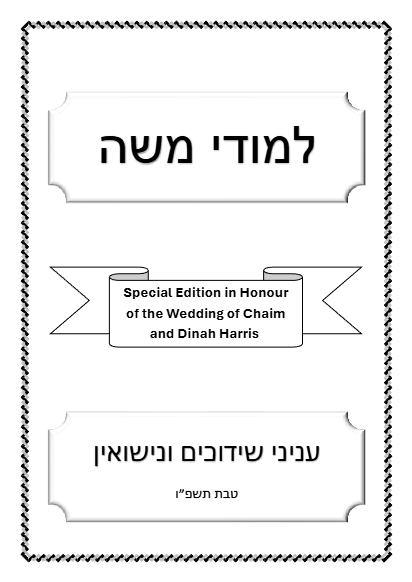

In Parshas Shoftim, the Torah introduces us to the concept of a Jewish Monarchy. “When you come to the land that Hashem your G-d gives you, and possess it and settle in it, and you will say ‘I will set a king over myself, like all the nations that are around me.’” (Devorim 17:14). The Torah says, “Yes you are allowed to establish a monarchy. It is a mitzvah to have a king.”

However, there are restrictions: He may not have an excessive number of wives. He may not have too many horses. He should not take too much silver and gold for himself. And there are also positive commandments: “And it shall be when he sits on the throne of his kingdom, he shall write for himself two copies of this Torah in a scroll from before the Kohanim, the Levites” (Devorim 17:18). Every Jew must write a Sefer Torah. The king needs to write a second Sefer Torah which he keeps with himself at all times.

The Torah introduces the mitzvah to write this (second) Sefer Torah with the expression “And it shall be when he sits (k’shivto) on the throne of his kingdom.” The Medrash in Esther Rabbah makes a very interesting comment. There are two ways of saying “And when he will sit on his throne.” It could say “v’haya k’shivto” or it could say “v’haya b’shivto.” The Medrash makes a distinction regarding the implications of each term. By the nations of the world, the pasuk says, “k‘sheves haMelech Achashverosh al kisei malchuso...” (Esther 1:2) using a letter “chaf” as the prefix. However, when we speak about Jewish kings in the Book of Shoftim (11:26), the pasuk says “b‘sheves Yisroel...” using the letter “beis” as the prefix. The Gemara explains the distinction: By the nations of the world, the “chaf” is used because their monarchies are not permanent. By kings of the Jewish nation, as long as there was a Klal Yisrael, the monarchy remained. Therefore, the prefix “beis” is used, which has a connotation of a permanent monarchy.

If that is the case, this pasuk in Parshas Shoftim presents a problem. It is speaking about a Jewish king and yet it uses the prefix “chof” – v’haya k’shivto al kisei mamlachto! This seems to violate the rule mentioned in Esther Rabbah.

I saw a thought in the name of the Gerrer Rebbe, the Chiddushei HaRim, and I saw a similar thought in the name of the Techeiles Mordechai from Rav Sholom Mordechai HaKohen Schwadron (the Brizhaner Rav). The reason the Torah uses the expression “And it will be k‘shivto...” here is because the Torah is speaking about the initial ascension of the Jewish king onto his throne. Normally, when a king first assumes his throne, he is all inspired and “pumped” to do good for the people. He wants to make sure the people are taken care of. He wants to make sure to improve the economy. He wants to make sure that human rights are preserved in his country. All the sincere and idealistic ideas of good government are always present when one starts something. Every president starts his administration with these grand ideas and grand plans to provide “a chicken in every pot and two cars in every garage and universal health care” etc., etc., etc.

Those plans are made “v’haya k’shivto...” (when he first ascends the throne). But we all know that with the passage of time, it rapidly becomes “same old, same old.” People become jaded; they become turned off; they get cynical. People sort of devolve into a run of the mill, go-through-the-motions type of administration.

The challenge always is for a king to maintain throughout his monarchy that same feeling of freshness, enthusiasm, and humility that he had the day he sat on the throne for the first time. This is what the Torah wants to hint at here, says the Brizhaner Rav. All the plans and good intentions that a king has when he assumes the throne (k’shivto al kisei malchuso) should remain with him for the rest of his reign.

This idea is a very beautiful vort to say at a sheva berachos. At a sheva berachos, the chosson and kallah are in their first week of marriage. They are so sensitive and so caring and so loving towards each other. They each have the greatest of intentions to make this a perfect marriage. But unfortunately, as we know, like with everything else in life – things do not remain the way they were at the start of an endeavor. Honeymoons are called honeymoons because they only last for a certain amount of time, unfortunately.

A chosson is compared to a king. That enthusiasm and that idealism and that commitment to be a good husband and to take care of the spouse and to respect and honor her should remain constant throughout the marriage as it was “k’shivto...” when he first ascended to the role of a chosson (who is compared to a king).”

Rav Pam once offered a beautiful thought. We say “v’erastich lee l’olam” (Hoshea 2:21) (And I will betroth you to me forever). Erusin [betrothal] is a temporary stage. It is the period between kiddushin [halachic engagement] and nisuin [halachic marriage]. In Talmudic times, it lasted for 6 to 12 months, but it was always meant to be a temporary situation. So, what then, asked Rav Pam, does the pasuk mean when it says, “I will betroth you to me forever”? If it is forever, it is not eirusin and if it is eirusin it is not forever?

Rav Pam said the same type of concept. When someone goes ahead and makes eirusin, he has all the good intentions and the love and compassion in the world, but it is only “eirusin” – a temporary stage. However, that type of “I will betroth you to me” should really be forever. (R’ Frand)

PDF Preview