Do a Mitzvah with Emunah and Hashem will give rewards in This World
Pardes Yehuda | August 07, 2025
Print This Article
View Original PDF

Do a Mitzvah with Emunah and Hashem will give rewards in This World

Pardes Yehuda | December 10, 2025

I entreated Hashem at that time, saying (3:23). Rashi quotes the Sifri: “I entreated:” The root of the Hebrew word iBj,t u, is "iUB j" signifying requesting a free gift. Even though the righteous tzaddikim, may base a request on the merit of their good deeds, they request of the Omnipresent only a free gift. The Liska Rebbe, (Harav Tzvi Hirsh Friedman, Yahrtzeit 14th of Av), in his sefer Ach Pri Tevuah, asks a powerful question: We see throughout the Torah the expression "saying" (xŸn` ¥l), “saying”. Denotes that Hashem told something, either a Halacha or a manner of behavior, to Moshe, to relate further to Klal Yisrael or someone else. However, how does the word “saying” fit into this Posuk that teaches that Moshe entreated Hashem?

The Liska Rebbe answers: Indeed, there is a message that Hashem wanted Moshe to relate to Klal Yisrael. Moshe Rabbeinu had enough merits to request that his prayers be answered. Yet, all he asked was for a free gift from Hashem. Now, when someone requests something from Hashem based on his merits, this might stem from arrogance, a feeling he is someone special. Hashem wanted that Klal Yisrael should learn the trait of humility from Moshe, and when someone prays, he should be humble, implying that he really does not merit anything. Hashem is the “Tov and Meitiv”, and always does for the whatever is for the true benefit of the person. Therefore, the word xŸn` ¥l, saying, means that Moshe is saying when I prayed to Hashem, and requested a free gift, it was out of humility; and if someone follows and prays when he is humble, Hashem will then answer the prayers. (Ach Pri Tevuah, Liska Rebbe)

There is still an interesting question that seems to emerge from our Rashi. A well-known general principle holds that there is no reward in This World for performing mitzvohs as seen in Gemara (.hlb''lwz elqk hi sc oiyeciw) noted from Parshas Vaeschanan which ends with mF−I ©d m « ̈zFU£r«©l "I command you today, to perform them", on which another Gemara (:b sc f''er) expands xgnl m « ̈zFU£r«©l mF−I ©d xky lawl "today to perform them, while not receiving reward until 'tomorrow', the Next World". But, we see in Rashi, that Tzaddikim may base a request on the merit of their good deeds, when if fact there is no reward in This World?

But many commentators ask on this concept of Hashem not paying in This World, when the Torah states "You shall not leave with you the payment of a worker overnight until the morning. (Vayikra 19:13) and in Parshas Ki Seitzei: “Give his wages on that day, and let the sun not set on him without payment, for he is poor and his life depends upon his employer, and otherwise, he will call out to Hashem about you and you be accountable for a sin.” (Devorim 24:15). Hence, there is obligation not to defer payment?

However, there are certain exceptions to this, that is when an employer himself doesn’t hire a worker only through an agency or through a messenger, there is no obligation on the employer. Hence, since it is known that the Ten Commandments, as well as the Torah given at Mount Sinai was said to Moshe, and he repeated it to the Yidden, it is considered as given through a messenger, and the obligation falls away. But, there is a problem with this, as the first two commandments, the Yidden heard directly from Hashem? The answer is that the first two commandments are related to Emunah in Hashem, and when a person does a Mitzvah with true Emunah, then for this Hashem gives a reward in this world. The proof is, that we know that a person who has Bitachon and faith in Hashem, will always get what he asks for. The reason is: that Bitachon is Emunah, and it says. "d¤i §g ¦iŸez ̈pEn ¡` ¤A wi ¦C ©v §e" “But the righteous person shall live by his faith” (Chabakkuk 2:4). From this we see that a Tzaddik lives with Emunah, therefore, he is entitled to rewards in This World. Now, the words of Rashi are brilliant: “Even though the righteous may base a request on the merit of their good deeds”,since they live with Emunah, they still only ask for a free gift.

(Yehuda Z Klitnick)
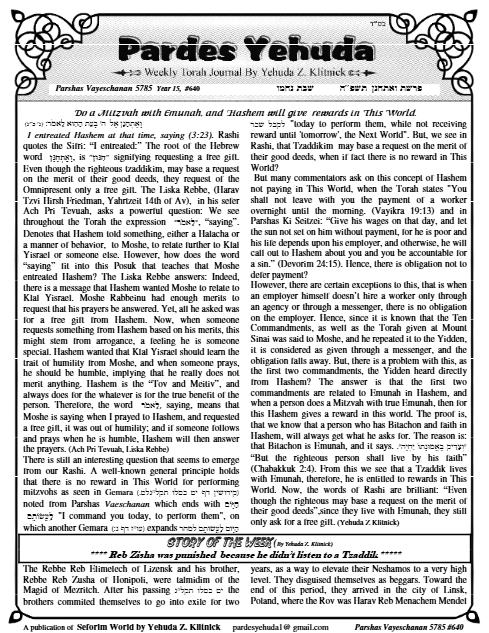
I entreated Hashem at that time, saying (3:23). Rashi quotes the Sifri: “I entreated:” The root of the Hebrew word iBj,t u, is "iUB j" signifying requesting a free gift. Even though the righteous tzaddikim, may base a request on the merit of their good deeds, they request of the Omnipresent only a free gift. The Liska Rebbe, (Harav Tzvi Hirsh Friedman, Yahrtzeit 14th of Av), in his sefer Ach Pri Tevuah, asks a powerful question: We see throughout the Torah the expression "saying" (xŸn` ¥l), “saying”. Denotes that Hashem told something, either a Halacha or a manner of behavior, to Moshe, to relate further to Klal Yisrael or someone else. However, how does the word “saying” fit into this Posuk that teaches that Moshe entreated Hashem?

The Liska Rebbe answers: Indeed, there is a message that Hashem wanted Moshe to relate to Klal Yisrael. Moshe Rabbeinu had enough merits to request that his prayers be answered. Yet, all he asked was for a free gift from Hashem. Now, when someone requests something from Hashem based on his merits, this might stem from arrogance, a feeling he is someone special. Hashem wanted that Klal Yisrael should learn the trait of humility from Moshe, and when someone prays, he should be humble, implying that he really does not merit anything. Hashem is the “Tov and Meitiv”, and always does for the whatever is for the true benefit of the person. Therefore, the word xŸn` ¥l, saying, means that Moshe is saying when I prayed to Hashem, and requested a free gift, it was out of humility; and if someone follows and prays when he is humble, Hashem will then answer the prayers. (Ach Pri Tevuah, Liska Rebbe)

There is still an interesting question that seems to emerge from our Rashi. A well-known general principle holds that there is no reward in This World for performing mitzvohs as seen in Gemara (.hlb''lwz elqk hi sc oiyeciw) noted from Parshas Vaeschanan which ends with mF−I ©d m « ̈zFU£r«©l "I command you today, to perform them", on which another Gemara (:b sc f''er) expands xgnl m « ̈zFU£r«©l mF−I ©d xky lawl "today to perform them, while not receiving reward until 'tomorrow', the Next World". But, we see in Rashi, that Tzaddikim may base a request on the merit of their good deeds, when if fact there is no reward in This World?

But many commentators ask on this concept of Hashem not paying in This World, when the Torah states "You shall not leave with you the payment of a worker overnight until the morning. (Vayikra 19:13) and in Parshas Ki Seitzei: “Give his wages on that day, and let the sun not set on him without payment, for he is poor and his life depends upon his employer, and otherwise, he will call out to Hashem about you and you be accountable for a sin.” (Devorim 24:15). Hence, there is obligation not to defer payment?

However, there are certain exceptions to this, that is when an employer himself doesn’t hire a worker only through an agency or through a messenger, there is no obligation on the employer. Hence, since it is known that the Ten Commandments, as well as the Torah given at Mount Sinai was said to Moshe, and he repeated it to the Yidden, it is considered as given through a messenger, and the obligation falls away. But, there is a problem with this, as the first two commandments, the Yidden heard directly from Hashem? The answer is that the first two commandments are related to Emunah in Hashem, and when a person does a Mitzvah with true Emunah, then for this Hashem gives a reward in this world. The proof is, that we know that a person who has Bitachon and faith in Hashem, will always get what he asks for. The reason is: that Bitachon is Emunah, and it says. "d¤i §g ¦iŸez ̈pEn ¡` ¤A wi ¦C ©v §e" “But the righteous person shall live by his faith” (Chabakkuk 2:4). From this we see that a Tzaddik lives with Emunah, therefore, he is entitled to rewards in This World. Now, the words of Rashi are brilliant: “Even though the righteous may base a request on the merit of their good deeds”,since they live with Emunah, they still only ask for a free gift.

(Yehuda Z Klitnick)
PDF Preview