Parshat Va’etchanan The Voice That Did Not Cease
Ben Chamesh L'Mikra | July 23, 2023
Print This Article
View Original PDF

Parshat Va’etchanan The Voice That Did Not Cease

Ben Chamesh L'Mikra | December 31, 2025

Parshat Va’etchanan

The Voice That Did Not Cease

By the Giving of the Torah the verse states that it was given with “a great voice, which did not cease.” The Medrash explains various interpretations as to the meaning of this statement. This Sicha analyzes the words of the Medrash and explains their significance to our daily lives.

This week’s parsha reviews the narrative of the Giving of the Torah and the Ten Commandments which the Israelites received from the Almighty. Concerning the voice of G-d that was heard during this tremendous delivery, Moshe related to the Israelites as follows:

Text 1
The Lord spoke these words to your entire assembly at the mountain out of the midst of the fire, the cloud, and the opaque darkness, with a great voice, which did not cease. And He inscribed them on two stone tablets and gave them to me.
Devarim 5:19

Regarding the significance of the statement that G-d spoke “with a great voice, which did not cease,” the Medrash enumerates a number of possibilities:

Text 2
The Lord spoke these words to your entire assembly...with a great voice, which did not cease. R. Yochanan stated: one voice divided into seven voices and those [seven] divided into seventy languages. R. Shimon ben Lakish stated that from it prophesized all prophets that stood. The Rabbis stated that it did not have an echo.
Medrash Rabba, Shemos 28:6

According to the first two explanations, it is evident why the voice of the Almighty was “a great voice, which did not cease.”
One voice divided into seven voices and those [seven] divided into seventy languages: It is understood that the voice was not limited to the Holy Tongue in which it was spoken, rather it “did not cease,” and was expressed in all other languages as well.
From it prophesized all prophets that stood: This statement transmits that the voice was not limited to the time in which it was said, but it rather is a continuous voice that is heard throughout the generations by way of the prophets and sages.

However, according to the explanation of the Medrash that “the voice did not have an echo,” the greatness of the voice is not understood. Rather than expressing the magnitude of the voice, on the contrary, it seems to express that voice was rather weak. As, the nature of the world is such that the greater the sound, the greater is the reverberation. By stating that the voice had no echo, the Medrash seems to express that the sound was feeble.
If the voice had no echo, what was so great about the voice?

Miracles for naught

One of the principles of the Torah is such that regarding the nature of the world, G-d does not change its governing rules which He created, and bring about a supernatural miracle unless there is some specific purpose in doing so.

Text 3
The first preface [in understanding nature] is that G-d, Blessed be He, wishes to preserve the nature of the world whenever possible, as nature is precious in His eyes. He only changes [nature] when there is an essential need.
Derashos HaRan 8

Yet, the nature of the world dictates that the greater the voice, the greater is its echo. It is understood therefore, that the voice heard at the giving of the Torah should have had a tremendous echo.
For what purpose then did G-d reverse the natural order of things at the Giving of the Torah, in that although the voice was “a great voice” which naturally has an echo, He nevertheless miraculously caused that it should have no echo?

No mistake

There are those who explain that there was indeed a requisite that this voice have no echo as were there to have been an echo the Jewish people may have erred concerning the origin of the voice.
Were there to have been an echo, one witnessing this event could have been mistaken to think that what they were hearing was not a reverberation of the same voice, but was another voice saying the same thing. Had this have happened, there would have been those that could have come to the conclusion that there was more than one G-d, G-d forbid. Therefore, it was indeed necessary that this voice have no echo so that no one could be mistaken as to the source of the voice.
This explanation though, is not entirely understood. Concerning the voice that was heard at the Giving of the Torah it is explained that the voice emanated from heaven, earth and all four directions:

Text 4
At the time of the Giving of the Torah the voice emanated from the east and Israel would hear and turn to the east to receive the Torah. When they came to east the voice would go to the west. When they turned to the west the voice would emanate from the north. When they went to the north the voice would emanate from the south. When they went to the south the voice would emanate from the heavens...Israel heard the voice from four sides and heaven and earth. They said, “Maybe there are many gods?” It is for this reason that the Torah writes, “I am the Lord,” [to say that] all that you hear is only coming from Me.
Balei HaTosfos, Shemos 20:2

The voice that the Israelites heard at the time of the Giving of the Torah emanated from all six directions and still G-d did not make a miracle to ensure that all were aware of the presence of only one G-d.
If G-d did not make a miracle in regard to a voice that emanated from six directions, there is all the less reason to create a miracle for an echo, where there is less concern for mistake.
When a person hears an echo, they hear the same sound and words of the original voice and the reverberations comes immediately following the original sound.
It is therefore highly unlikely that the Israelites would have been made an erroneous conclusion that the voice was from a different source other than G-d. Hence, it seems that this phenomenon of there being no echo in the voice was superfluous.
Another question on this verse can be drawn from the fact that the Torah is not merely a story book of the Jewish people’s history, but rather, everything mentioned in it contains a lesson in our service of G-d.
What can possibly be the lesson in the idea that the voice heard by the Giving of the Torah had no echo?

Opening statements

The opening statement by the Giving of the Torah was, “I am the Lord your G-d.” The Hebrew word that the Torah uses for the word “I” is Anochi. Concerning this word the Talmud explains that therein lies a hint to the manner in which G-d gave us the Torah and that the word Anochi is itself an acronym:

Text 5
[I — Anochi]. I[Ana] have Myself [Nafshis] been written into the Script [Kesibah Yehabith].
Talmud, Shabbos 105a

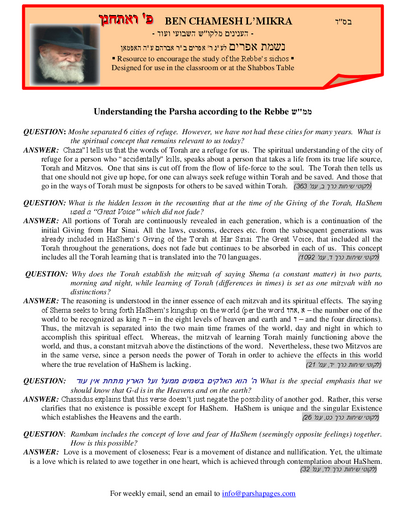
When G-d gave the Ten Commandments, He placed Himself within them and gave Himself both to the Jewish people who were present and to the Jewish people who were to come in all subsequent generations. To all of them he stated “I am the Lord your G-d” in a personal way and transmitted His very essence to them.
A person, however, can think that while it is true that they are able to touch the essence of G-d in the fulfillment of the Ten Commandments, they cannot reach G-d’s essence in the rest of the subsequent mitzvos that were given after the Ten Commandments, as well as the mitzvos the ideas of Torah that were revealed by the prophets and the sages as those mitzvos were seemingly not given from the essence of G-d.
It is known that the words of the sages are the spirit of G-d as Tanya explains:

Text 6
Even the books on piety, whose basis is in the peaks of holiness, the Midrashim of our Sages, of blessed memory, through whom the spirit of G-d speaks and His word is on their tongue.
Tanya, Compiler’s Forward

A person can however be mistaken and think, that while it is true that the words of the sages are G-dly, they are nevertheless not on the same level of G-dliness as the Ten Commandments.
To negate this mistake the verse states that G-d spoke “with a great voice, which did not cease.” All the words of the prophets and subsequent sages are merely an extension of the voice that was heard at the Giving of the Torah.
This is the intent of the Medrash’s words in its statement that from the voice heard at the Giving of the Torah came the prophecy of all the prophets throughout the generations. That the essence of G-d is not only expressed in the Ten Commandments but the rest of the Torah as well.
Concerning all of Torah can the statement “I am the Lord your G-d” be applied. Meaning to say, that the essence of G-d (so to speak) is communicating His intentions to every Jew in a particular manner. A Jew connects to G-d’s essence not only when he fulfills the Ten Commandments, but when he fulfills the words of the sages as well.
This is as well the meaning of the voice dividing into the seventy languages:
Non-Jewish people are commanded to keep the Seven Noachide Laws and the Jewish people are obligated to encourage them to do so.

A person is likely to assume that although non-Jewish people are commanded to fulfill the Noachide Laws, they are laws that are separate from the Torah.
To negate this mistake, the Torah as well states that the voice heard at the Giving of the Torah was “a great voice, which did not cease.” On this the Medrash elaborates that the voice “divided into seventy languages.”
Parshat Va’etchanan

The Voice That Did Not Cease

By the Giving of the Torah the verse states that it was given with “a great voice, which did not cease.” The Medrash explains various interpretations as to the meaning of this statement. This Sicha analyzes the words of the Medrash and explains their significance to our daily lives.

This week’s parsha reviews the narrative of the Giving of the Torah and the Ten Commandments which the Israelites received from the Almighty. Concerning the voice of G-d that was heard during this tremendous delivery, Moshe related to the Israelites as follows:

Text 1
The Lord spoke these words to your entire assembly at the mountain out of the midst of the fire, the cloud, and the opaque darkness, with a great voice, which did not cease. And He inscribed them on two stone tablets and gave them to me.
Devarim 5:19

Regarding the significance of the statement that G-d spoke “with a great voice, which did not cease,” the Medrash enumerates a number of possibilities:

Text 2
The Lord spoke these words to your entire assembly...with a great voice, which did not cease. R. Yochanan stated: one voice divided into seven voices and those [seven] divided into seventy languages. R. Shimon ben Lakish stated that from it prophesized all prophets that stood. The Rabbis stated that it did not have an echo.
Medrash Rabba, Shemos 28:6

According to the first two explanations, it is evident why the voice of the Almighty was “a great voice, which did not cease.”
One voice divided into seven voices and those [seven] divided into seventy languages: It is understood that the voice was not limited to the Holy Tongue in which it was spoken, rather it “did not cease,” and was expressed in all other languages as well.
From it prophesized all prophets that stood: This statement transmits that the voice was not limited to the time in which it was said, but it rather is a continuous voice that is heard throughout the generations by way of the prophets and sages.

However, according to the explanation of the Medrash that “the voice did not have an echo,” the greatness of the voice is not understood. Rather than expressing the magnitude of the voice, on the contrary, it seems to express that voice was rather weak. As, the nature of the world is such that the greater the sound, the greater is the reverberation. By stating that the voice had no echo, the Medrash seems to express that the sound was feeble.
If the voice had no echo, what was so great about the voice?

Miracles for naught

One of the principles of the Torah is such that regarding the nature of the world, G-d does not change its governing rules which He created, and bring about a supernatural miracle unless there is some specific purpose in doing so.

Text 3
The first preface [in understanding nature] is that G-d, Blessed be He, wishes to preserve the nature of the world whenever possible, as nature is precious in His eyes. He only changes [nature] when there is an essential need.
Derashos HaRan 8

Yet, the nature of the world dictates that the greater the voice, the greater is its echo. It is understood therefore, that the voice heard at the giving of the Torah should have had a tremendous echo.
For what purpose then did G-d reverse the natural order of things at the Giving of the Torah, in that although the voice was “a great voice” which naturally has an echo, He nevertheless miraculously caused that it should have no echo?

No mistake

There are those who explain that there was indeed a requisite that this voice have no echo as were there to have been an echo the Jewish people may have erred concerning the origin of the voice.
Were there to have been an echo, one witnessing this event could have been mistaken to think that what they were hearing was not a reverberation of the same voice, but was another voice saying the same thing. Had this have happened, there would have been those that could have come to the conclusion that there was more than one G-d, G-d forbid. Therefore, it was indeed necessary that this voice have no echo so that no one could be mistaken as to the source of the voice.
This explanation though, is not entirely understood. Concerning the voice that was heard at the Giving of the Torah it is explained that the voice emanated from heaven, earth and all four directions:

Text 4
At the time of the Giving of the Torah the voice emanated from the east and Israel would hear and turn to the east to receive the Torah. When they came to east the voice would go to the west. When they turned to the west the voice would emanate from the north. When they went to the north the voice would emanate from the south. When they went to the south the voice would emanate from the heavens...Israel heard the voice from four sides and heaven and earth. They said, “Maybe there are many gods?” It is for this reason that the Torah writes, “I am the Lord,” [to say that] all that you hear is only coming from Me.
Balei HaTosfos, Shemos 20:2

The voice that the Israelites heard at the time of the Giving of the Torah emanated from all six directions and still G-d did not make a miracle to ensure that all were aware of the presence of only one G-d.
If G-d did not make a miracle in regard to a voice that emanated from six directions, there is all the less reason to create a miracle for an echo, where there is less concern for mistake.
When a person hears an echo, they hear the same sound and words of the original voice and the reverberations comes immediately following the original sound.
It is therefore highly unlikely that the Israelites would have been made an erroneous conclusion that the voice was from a different source other than G-d. Hence, it seems that this phenomenon of there being no echo in the voice was superfluous.
Another question on this verse can be drawn from the fact that the Torah is not merely a story book of the Jewish people’s history, but rather, everything mentioned in it contains a lesson in our service of G-d.
What can possibly be the lesson in the idea that the voice heard by the Giving of the Torah had no echo?

Opening statements

The opening statement by the Giving of the Torah was, “I am the Lord your G-d.” The Hebrew word that the Torah uses for the word “I” is Anochi. Concerning this word the Talmud explains that therein lies a hint to the manner in which G-d gave us the Torah and that the word Anochi is itself an acronym:

Text 5
[I — Anochi]. I[Ana] have Myself [Nafshis] been written into the Script [Kesibah Yehabith].
Talmud, Shabbos 105a

When G-d gave the Ten Commandments, He placed Himself within them and gave Himself both to the Jewish people who were present and to the Jewish people who were to come in all subsequent generations. To all of them he stated “I am the Lord your G-d” in a personal way and transmitted His very essence to them.
A person, however, can think that while it is true that they are able to touch the essence of G-d in the fulfillment of the Ten Commandments, they cannot reach G-d’s essence in the rest of the subsequent mitzvos that were given after the Ten Commandments, as well as the mitzvos the ideas of Torah that were revealed by the prophets and the sages as those mitzvos were seemingly not given from the essence of G-d.
It is known that the words of the sages are the spirit of G-d as Tanya explains:

Text 6
Even the books on piety, whose basis is in the peaks of holiness, the Midrashim of our Sages, of blessed memory, through whom the spirit of G-d speaks and His word is on their tongue.
Tanya, Compiler’s Forward

A person can however be mistaken and think, that while it is true that the words of the sages are G-dly, they are nevertheless not on the same level of G-dliness as the Ten Commandments.
To negate this mistake the verse states that G-d spoke “with a great voice, which did not cease.” All the words of the prophets and subsequent sages are merely an extension of the voice that was heard at the Giving of the Torah.
This is the intent of the Medrash’s words in its statement that from the voice heard at the Giving of the Torah came the prophecy of all the prophets throughout the generations. That the essence of G-d is not only expressed in the Ten Commandments but the rest of the Torah as well.
Concerning all of Torah can the statement “I am the Lord your G-d” be applied. Meaning to say, that the essence of G-d (so to speak) is communicating His intentions to every Jew in a particular manner. A Jew connects to G-d’s essence not only when he fulfills the Ten Commandments, but when he fulfills the words of the sages as well.
This is as well the meaning of the voice dividing into the seventy languages:
Non-Jewish people are commanded to keep the Seven Noachide Laws and the Jewish people are obligated to encourage them to do so.

A person is likely to assume that although non-Jewish people are commanded to fulfill the Noachide Laws, they are laws that are separate from the Torah.
To negate this mistake, the Torah as well states that the voice heard at the Giving of the Torah was “a great voice, which did not cease.” On this the Medrash elaborates that the voice “divided into seventy languages.”

PDF Preview