Divine Protection
BET Journal | November 27, 2025
Print This Article
View Original PDF

Divine Protection

BET Journal | December 07, 2025

And the angels of Hashem encountered him (Yaakov) (32:2)

The Meforshim ask: Why did Yaakov need to be accompanied by angels? Hadn’t Hashem promised Yaakov Avinu (28:15), “I will be with you and watch over you”? Furthermore, in Yaakov Avinu’s dream, Rashi explains that the angels descending the ladder were in order to accompany him in Chutz la’Aretz. Nevertheless, it was in that very dream that Hashem informed Yaakov Avinu that He would be with him and protect him. The Zera Shimshon asks: Why did Yaakov Avinu need two forms of protection?

The Zera Shimshon answers these questions with a very interesting concept.

The protection given by angels is different than that given by Hashem Himself. The angels that protect a person are those created by his own good deeds. They are obligated to protect him from all harm. This kind of protection does not subtract from his merits. However, the protection he receives from these angels is only in accordance with the laws of nature. They will not protect him in a supernatural fashion.

On the other hand, when one merits being protected directly by Hashem, the protection is above the laws of nature, and one is protected in a supernatural manner. The result of this is that this protection diminishes from his eternal reward, as the Gemara (Shabbos 32a) teaches regarding one who is saved by a miracle.

However, when a tzaddik merits a special promise from Hashem that He will protect him, as Yaakov Avinu did, this kind of protection is above the laws of nature and does not subtract from one’s merits, since otherwise, of what benefit would such a promise be?

When a person indeed merits protection directly from Hashem, in reality, there is no need for the angels to protect him. The only reason they do is as we find in the Bais HaMikdash. The Mishna (Middos 1:1, see the Bartenura) says that the need for guards in the Bais HaMikdash was not to ensure that robbers and the like didn’t plunder the wealth found in the Bais HaMikdash, since Hashem Himself watched over it. Rather, the ‘guards’ of Kohanim and Levi’im were in reality an ‘honor guard.’ When Hashem protects an individual, the angels accompanying the person also only serve as an ‘honor guard.’

Another difference between the protection given by angels versus that given by Hashem is what the Gemara (Sota 21a) teaches, that since one’s sins can wipe out his mitzvos, the angels that were created by his mitzvos protect him from sin for their own good, since they do not want to be rejected from their posts. However, when Hashem protects a person, even though He saves him from the yetzer hara, He doesn’t take his free will away from him. Instead, Hashem strengthens the person’s yetzer hatov to overpower his yetzer hara.

Yet another difference is that once a person does sin, the angels that protect him distance themselves from him, and he thus loses their protection. When Hashem protects an individual, even after he sins, out of His mercy, Hashem gives the person room and time to repent before He punishes Him and removes His protection.

There are differences between the protection that one gets from angels versus that which one receives from Hashem, and the Zera Shimshon says that in some cases, one protection benefits the person over the other. This is why Yaakov Avinu merited both forms of protection, to have the benefits of both.

ZERA SHIMSHON

ZERA SHIMSHON SHIUR

BY RABBI SIMCHA BUNIM BURGER
THURSDAY 8:15 PM - 9:15 PM (20 Upstairs)

Please scan to join Zera Shimshon Whatsapp Group
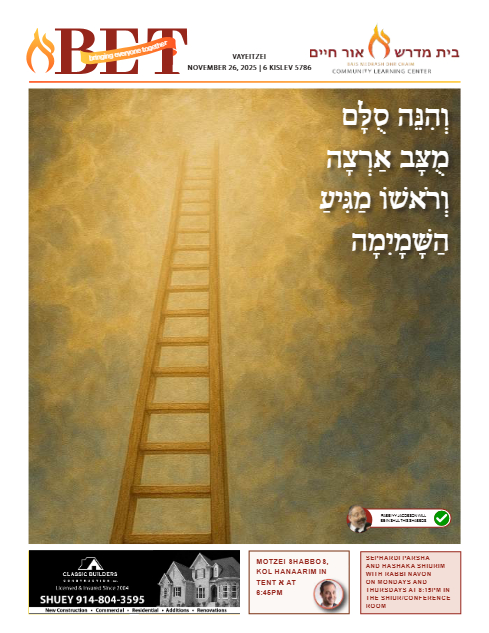
And the angels of Hashem encountered him (Yaakov) (32:2)

The Meforshim ask: Why did Yaakov need to be accompanied by angels? Hadn’t Hashem promised Yaakov Avinu (28:15), “I will be with you and watch over you”? Furthermore, in Yaakov Avinu’s dream, Rashi explains that the angels descending the ladder were in order to accompany him in Chutz la’Aretz. Nevertheless, it was in that very dream that Hashem informed Yaakov Avinu that He would be with him and protect him. The Zera Shimshon asks: Why did Yaakov Avinu need two forms of protection?

The Zera Shimshon answers these questions with a very interesting concept.

The protection given by angels is different than that given by Hashem Himself. The angels that protect a person are those created by his own good deeds. They are obligated to protect him from all harm. This kind of protection does not subtract from his merits. However, the protection he receives from these angels is only in accordance with the laws of nature. They will not protect him in a supernatural fashion.

On the other hand, when one merits being protected directly by Hashem, the protection is above the laws of nature, and one is protected in a supernatural manner. The result of this is that this protection diminishes from his eternal reward, as the Gemara (Shabbos 32a) teaches regarding one who is saved by a miracle.

However, when a tzaddik merits a special promise from Hashem that He will protect him, as Yaakov Avinu did, this kind of protection is above the laws of nature and does not subtract from one’s merits, since otherwise, of what benefit would such a promise be?

When a person indeed merits protection directly from Hashem, in reality, there is no need for the angels to protect him. The only reason they do is as we find in the Bais HaMikdash. The Mishna (Middos 1:1, see the Bartenura) says that the need for guards in the Bais HaMikdash was not to ensure that robbers and the like didn’t plunder the wealth found in the Bais HaMikdash, since Hashem Himself watched over it. Rather, the ‘guards’ of Kohanim and Levi’im were in reality an ‘honor guard.’ When Hashem protects an individual, the angels accompanying the person also only serve as an ‘honor guard.’

Another difference between the protection given by angels versus that given by Hashem is what the Gemara (Sota 21a) teaches, that since one’s sins can wipe out his mitzvos, the angels that were created by his mitzvos protect him from sin for their own good, since they do not want to be rejected from their posts. However, when Hashem protects a person, even though He saves him from the yetzer hara, He doesn’t take his free will away from him. Instead, Hashem strengthens the person’s yetzer hatov to overpower his yetzer hara.

Yet another difference is that once a person does sin, the angels that protect him distance themselves from him, and he thus loses their protection. When Hashem protects an individual, even after he sins, out of His mercy, Hashem gives the person room and time to repent before He punishes Him and removes His protection.

There are differences between the protection that one gets from angels versus that which one receives from Hashem, and the Zera Shimshon says that in some cases, one protection benefits the person over the other. This is why Yaakov Avinu merited both forms of protection, to have the benefits of both.

ZERA SHIMSHON

ZERA SHIMSHON SHIUR

BY RABBI SIMCHA BUNIM BURGER
THURSDAY 8:15 PM - 9:15 PM (20 Upstairs)

Please scan to join Zera Shimshon Whatsapp Group

PDF Preview